- Home
- News
News
Discussion: How Many and What Kind of Migrants Does Lithuania Need?
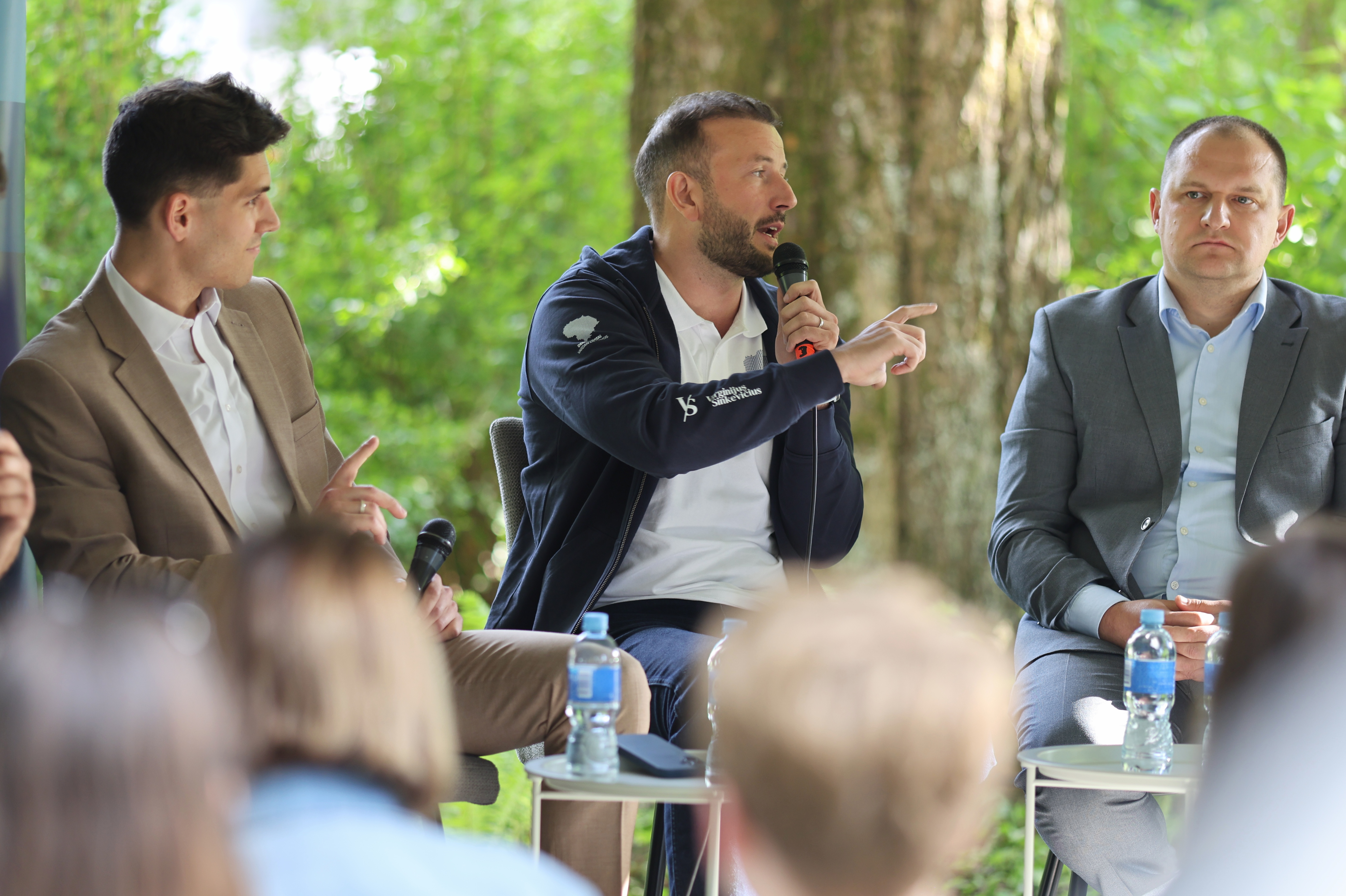
On August 28, a discussion organized by the European Migration Network (EMN) in Lithuania took place at the “Būtent!” discussion festival, focusing on how many migrants Lithuania needs and what types of migrants would best serve the country’s future.
The discussion featured Laurynas Kasčiūnas, Chairman of the Homeland Union-Lithuanian Christian Democrats; Adomas Klimantas, economist at Investors’ Forum; Virginijus Sinkevičius, Chairman of the Democratic Union “For Lithuania”; and Gediminas Pocius, Head of the Reception and Integration Agency.
Direction, Not Numbers
The employment quota approved for 2026 allows for the recruitment of 25,000 foreign workers, representing approximately 0.9% of Lithuania’s permanent population, which stood at around 2.9 million residents on July 1, 2025, according to the State Data Agency.
However, the debate is increasingly shifting away from the number of migrants and toward a more strategic question: what qualifications does Lithuania actually need, and what kind of country does it want to become?
According to Virginijus Sinkevičius, this is a fundamental issue for the coming years: “If we want higher value-added industries and want to avoid the middle-income trap, then it is clear that we need to focus on attracting higher-skilled professionals.”
Adomas Klimantas noted that the current reality is quite different. People generating high added value account for only a small share of arrivals, approximately 5%. “We should discuss how to ensure that a larger share of incoming migrants are talents,” he said, encouraging the state to make a deliberate effort to attract educated professionals to Lithuania.
The discussion moderator, LRT presenter Audra Avižiūtė, asked: “what can we do today to make Lithuania stand out and become more visible?”
Klimantas highlighted two main factors that could attract talent: public safety and the country’s image. “We increasingly hear from newcomers that they want to be here because Lithuania is very safe. Look at the image Estonia has built over the last 20 years: a European startup capital and one of the best places to live and do business. Perhaps we can create a similar image, so that a highly qualified engineer sees Lithuania as a worthwhile destination.”
Lessons from Western Europe
Laurynas Kasčiūnas argued that Lithuania should learn from the mistakes of Western Europe and develop a “controlled immigration policy.” He pointed to two different integration models: the Swedish model, which emphasizes diversity; and the French model, which is based on assimilation.
According to Kasčiūnas, Sweden’s approach did not achieve the expected results and failed to prevent the formation of closed communities.
The French model, on the other hand, follows an assimilation strategy: “If you want to feel French in France, you must learn the language and adopt the culture.” While this approach might seem more effective than the Swedish model, Kasčiūnas noted that France has also experienced the persistence of isolated communities, suggesting that assimilation alone does not fully solve integration challenges.
In his opinion, safeguards and policy measures must be established today to prevent future developments from becoming irreversible.
Migration Is Not a Monolithic Process
According to Gediminas Pocius, discussions about migration often oversimplify the issue by treating migration as a single phenomenon. In Lithuania’s case, however, there are distinct groups of migrants, including: Ukrainians who arrived because of the war; Belarusians with varying reasons for migration; labour migrants; asylum seekers.
For this reason, Pocius argued that each group should be considered separately. Different groups require different integration approaches. For example, expectations regarding a person granted asylum differ from those regarding someone who has arrived temporarily for work. Therefore, it is important to clearly communicate two key messages to every group: what rights and opportunities the state provides; what expectations the state has of newcomers.
Klimantas expanded on this idea, arguing that the government must tailor its communication to three different audiences: migrants; businesses; society as a whole.
The Responsibility of Business
Virginijus Sinkevičius emphasized that employers must play a greater role in integration: “A company’s responsibility cannot end with simply bringing someone here and providing a job.”
He also argued that the state should monitor situations where large numbers of migrants concentrate in specific areas to prevent the emergence of closed communities.
Klimantas agreed, stating that businesses should be viewed as a key component of Lithuania’s migration and integration strategy.
Integration: From Temporary Status to an Integration Law
Gediminas Pocius stressed that uncertainty about the future weakens migrants’ motivation to integrate: “If a person faces significant uncertainty regarding their future and prospects, then obligations and rights automatically seem less important as well.”
He noted that Lithuania currently has a structured integration program only for individuals who have been granted asylum. Approximately 400–500 people participate in this program each year, about two-thirds of whom are citizens of Belarus. Participants receive an integration plan with clearly defined criteria, including: employment measures; lithuanian language learning; specific integration goals. The program typically lasts between one and one and a half years.
According to Pocius, elements of this model could be adapted for a broader range of migrants.
A member of the audience pointed out that Lithuania still lacks a comprehensive integration law defining what successful integration means for different migrant groups.
What's Next? Experts’ Priorities
When asked to name one priority and one criterion that could be used to evaluate policy success ten years from now, the participants offered different answers.
Laurynas Kasčiūnas identified a requirement to demonstrate knowledge of the state language when renewing residence permits; a quota system as a tool for managing migration flows.
Adomas Klimantas stressed the need for a long-term strategy and clear national vision; a precise understanding of what skills are needed, how many people are required, and when. He also expressed hope that Lithuania could move closer to Finland’s level of development within the next decade.
Virginijus Sinkevičius agreed on the importance of a strategy, adding that the state must finally answer the question of how many migrants Lithuania needs and what types of migrants they should be.
Gediminas Pocius called for an agreement on migration policy; adoption of an integration law; clearly defined integration criteria; decision-making based on long-term data and objective assessments of migration’s impact on the state.
The full discussion can be viewed here: https://www.youtube.com/watch?v=iuCSG9qY98g
The European Migration Network (EMN) is a network of EU Member States, observer countries, and the European Commission that collects, analyzes, and shares up-to-date, objective, and comparable information on migration and asylum issues. The project is funded by the EU Asylum, Migration and Integration Fund (AMIF) 2021–2027.


-2288f5556ae2502c54396f38a9cd2d4a.png)