- Home
- News
News
Experts outlined the expectations for migrant integration in Lithuania
From 2026, foreigners living in Lithuania and working in the service sector will be required to have at least a basic knowledge of the Lithuanian language. The law stipulates that thousands of migrants working in the country will need to acquire at least minimal language skills, while employers will have to ensure that services are provided in Lithuanian. This new requirement highlights the issue of the successful integration of migrants living in Lithuania.
Currently, there are more than 200,000 foreigners living in Lithuania, of whom as many as 106,400 have temporary residence permits for work purposes. For many of them, successful integration requires not only getting to know the local culture and traditions, but also learning the Lithuanian language. From next year, this will no longer be a recommendation but a requirement.
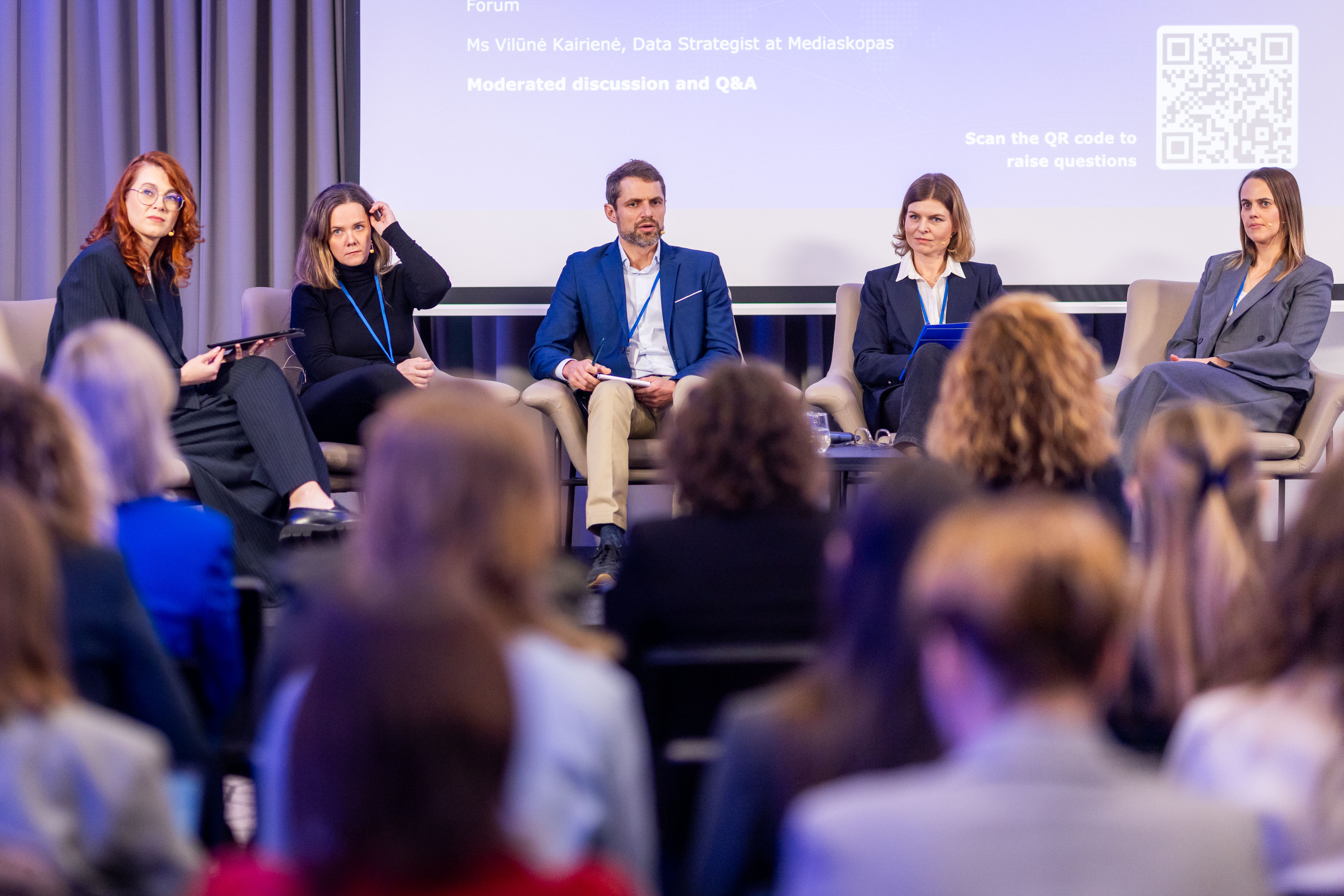
Experts discussed these changes and broader challenges of migrant integration at a conference organized by the European Migration Network in Vilnius.
“Employers often ask: is it really necessary to teach long-distance drivers Lithuanian if they mainly drive around Europe? In my opinion, at least A1-level basics of Lithuanian are essential. It’s a bit like getting a vaccine – perhaps not the most pleasant process, but a necessary one, because it later makes it easier for a person to integrate into society,” said Laura Perevičiūtė, Head of the Foreigners’ Integration Division at the Ministry of Social Security and Labour.
According to her, a lack of language skills in Lithuania becomes a barrier to accessing help and defending one’s rights: “If an employer exploits you and you do not know the language, you will not be able to access services or know where to turn. Therefore, learning the language is not just 'our desire', it must also be in the person's own interest," said L. Perevičiūtė.
At the national level, measures are already being considered to make Lithuanian language teaching more systematic and better coordinated. “I would like to see the adoption of an amendment to the law that would oblige the government to appoint a coordinating institution for Lithuanian language teaching. At the moment, there is a significant lack of clear allocations of responsibility,” emphasized L. Perevičiūtė.
Integration is not just about language skills
Nevertheless, experts agree that language proficiency is not the only aspect of successful integration.
“Language skills help to avoid many misunderstandings, but successful integration is not limited to language alone. First and foremost, foreigners need clear, understandable information about their rights, obligations, and where to turn when they need assistance – only then can they successfully begin their new lives in Lithuania,” says Aistė Kasperė, Head of the Migration Information Centre (IOM Lithuania).
According to her, it is necessary to define more clearly what is considered integration and when we can say that it has been successful.
“At MiCenter, we provide around 700 consultations per month, so we clearly see that people still lack clarity and practical support, especially when their situations fall under the competence of several institutions. It is important to remember that integration is a two-way process involving both migrants and the host society. If we foster respectful, open, and humane relationships, we will avoid many challenges,” emphasizes A. Kasperė.
According to L. Perevičiūtė, migrant integration is a long-term process spanning several decades, which also includes the children of newcomers.
“Integration is a very large, complex set of factors that a person has to experience in order to feel like part of society. It is a 40–50-year issue that also involves the next generation. Research shows that even after 10 years, people may still not be considered fully integrated, so it is very difficult to draw a clear line as to when an ‘employee is integrated’ and when they are not,” notes L. Perevičiūtė.
When asked how to motivate people who are not motivated themselves, she points out that we often forget to look at the situation from the migrant's perspective: why does a person living in Lithuania say that they do not want to be part of this society? "If they live in uncertainty about their status for a year or two and experience rejection, it is natural that they become disappointed. Then the question is: is the problem really just that the person 'does not want to integrate'?" comments L. Perevičiūtė.
Employers can be a bridge to society
The participants of the discussion agreed that employers must also play a role in migrant integration. They influence not only migrants’ everyday experiences in the workplace, but also broader societal attitudes toward people arriving from other countries.
"When a highly skilled employee from abroad joins the team, it is important that they feel comfortable in society. A mature employer invests not only in professional training but also in adaptation: explaining processes and expectations, and helping employees understand the European work model. This applies to both highly qualified specialists and those considered lower-skilled,” says Jurgis Kovas, CEO of the recruitment company Biuro and a member of the Investors’ Forum Talent Team.
He points out that situations, when people buy migration packages themselves and employers do not actually participate in the selection process, poses serious risks. “In such cases, integration is left aside – the employee arrives, and if they are not suitable, they are dismissed. What happens to the person afterward is no longer followed by anyone. This creates no benefit for either the employer or the state,” J. Kovas said.
As a good example, he mentions the Philippines, where integration begins even before leaving the country. “They organize seminars about the culture of the destination country, work regulations, and rights. What we try to create through employer initiatives, in Philippines functions as a coherent state policy,” he says.
Media also plays a role in shaping attitudes towards migrants
In Lithuania, public attitudes toward migrants are largely shaped by the media. According to Vilūnė Kairienė, a data strategist at the media monitoring and analysis company Mediaskopas, two-thirds of people form their opinions based on news rather than personal experience.
“Only about 10% of media content is devoted to migrant integration topics, while crime stories make up a similar share—but they receive the most attention. This creates the impression that migration is primarily a risk,” says V. Kairienė.
She notes that success stories shared by businesses can significantly influence public opinion. The experiences of Ukrainians living in Lithuania have already demonstrated this: more positive messages have contributed to a more favorable public attitude.
The EMN (European Migration Network) is a network of EMN member states, observer countries, and the European Commission, aimed at collecting, analyzing, and sharing the latest objective and comparable information on migration and asylum. The project is funded by the EU Asylum, Migration and Integration Fund (2021–2027).


-2288f5556ae2502c54396f38a9cd2d4a.png)